
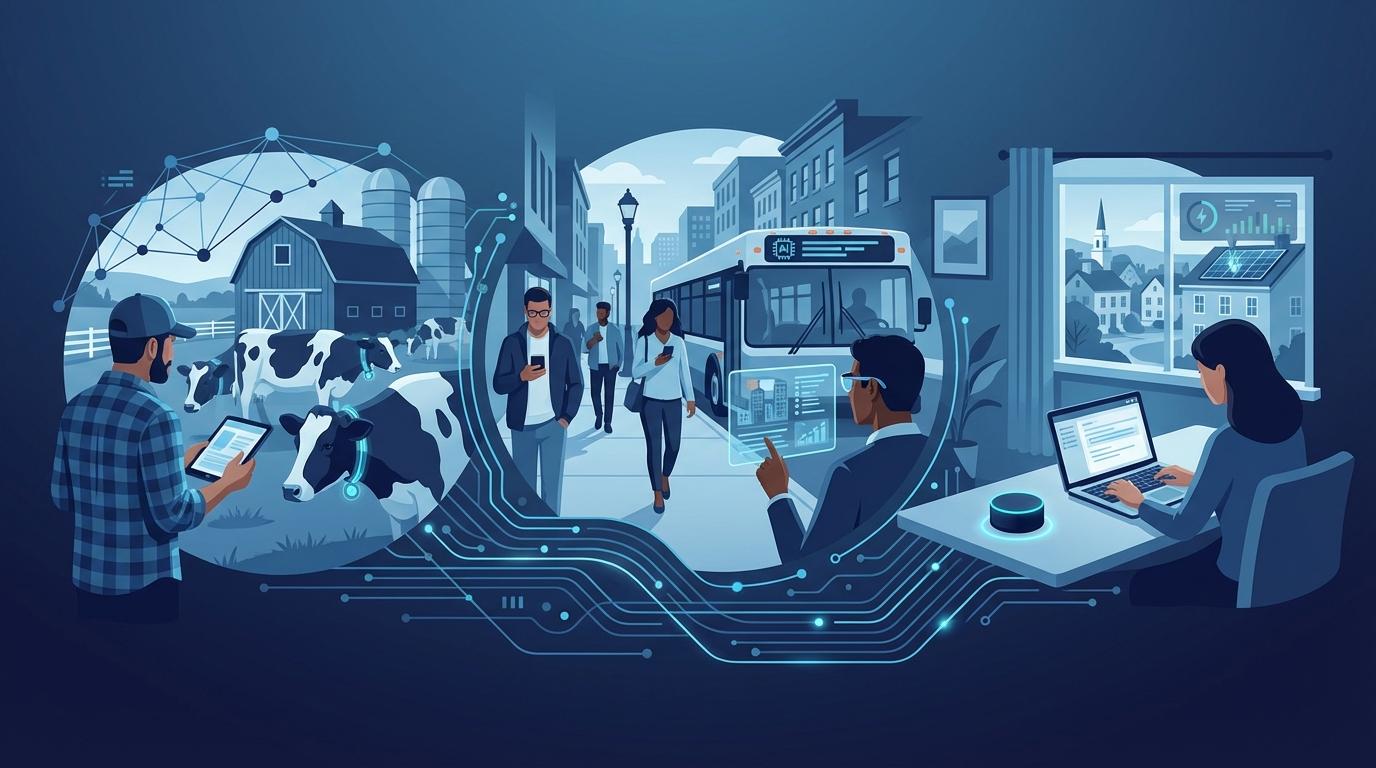
Forget the robots. Forget the dystopian headlines and the breathless tech conference keynotes. If you want to understand what AI actually looks like in 2026, don't look at San Francisco — look at Concord. Look at Manchester. Look at a dairy farm in Grafton County at 5am.
Because that's where the real story is.
It's Quieter Than You'd Expect
One of the most surprising things about AI in everyday New Hampshire life is how... unremarkable it feels most of the time. Not in a disappointing way. In a good way. The technology has settled into the background of daily routines the way GPS did a decade ago. You don't think about it. It just works, and you get on with your day.
Take the small business owner in Portsmouth running a boutique hospitality company. She's using an AI assistant to handle first-draft responses to guest inquiries, flag double-bookings before they happen, and generate seasonal marketing copy. She told me she spends maybe 20 minutes a day actually interacting with it directly. The rest of the time it's just... there, doing stuff. She's not an AI person. She doesn't follow the research. She just needed something that helped her stop working 14-hour days, and now she works 10-hour days instead. Progress.
Agriculture Is Having a Quiet Revolution
New Hampshire's farming community doesn't always make the tech headlines, but some genuinely interesting things are happening in the fields and barns of this state. Precision agriculture tools — many of them now AI-powered under the hood — are helping small farms do things that used to require consultants or expensive equipment.
Soil moisture sensors paired with predictive models are telling farmers when to irrigate and when to hold off, factoring in hyperlocal weather forecasts that are way more granular than anything the Weather Channel ever offered. A vegetable grower in the Lakes Region mentioned he's cut his water usage significantly this season, not because he got more disciplined, but because the system just tells him what to do and he does it.
Is it transformative? Sort of. It's more like... a really smart, tireless farmhand who never takes a day off and doesn't need health insurance. Which, honestly, for a small operation running on thin margins, that matters enormously.
Healthcare Workers Are Cautiously Optimistic
Talk to nurses and physicians at smaller NH hospitals and community health centers and you'll get a mixed but mostly hopeful picture. AI-assisted documentation has been the biggest practical shift for a lot of clinical staff. The hours spent on after-visit notes and coding — hours that used to eat into evenings and weekends — have shrunk considerably for many providers who've adopted ambient documentation tools.
One family practice doc in Keene described it as getting "two hours of her life back every day." That's not nothing. That's dinner with her kids.
That said, there's real caution too. Nobody's handing over clinical decisions to an algorithm, and the good providers are clear-eyed about where AI helps and where it can confidently give you the wrong answer. The trust has to be earned, and it's being earned slowly, which is probably the right pace.
Schools Are Figuring It Out in Real Time
Honestly, education is the messiest part of this picture, and it'd be dishonest to pretend otherwise. New Hampshire schools are all over the map in terms of how they're handling AI. Some districts have leaned in, training teachers to use AI tools for lesson differentiation and giving students structured ways to work with AI rather than just copying from it. Others are still mostly in reactive mode, updating honor codes and hoping for the best.
The schools getting it right seem to share one thing: they stopped treating AI as a cheating problem and started treating it as a literacy problem. Teaching kids to critically evaluate AI outputs, to know when the tool is confidently wrong, to use it as a thinking partner rather than a shortcut — that's the actual skill that matters. A few NH educators are doing genuinely creative work here and it deserves way more attention than it gets.
The Commute, the Grocery Store, the Weekend
Outside of work, AI has crept into the mundane corners of life in ways most people barely notice. Route optimization on navigation apps has gotten eerily good at predicting traffic on I-93 during ski season. Local retailers are using demand forecasting tools to keep shelves stocked without over-ordering — a real issue for smaller grocery stores that don't have the inventory buffers of a big chain.
Personal finance apps are nudging people toward better decisions with AI-generated spending summaries that are actually readable and specific, not just generic pie charts. And smart home devices have gotten considerably better at understanding context — your thermostat now knows you come home late on Thursdays and adjusts accordingly without you ever setting a rule.
None of this is headline-grabbing. But accumulated across a week, across a year? It adds up to a life that runs a little smoother, with fewer of the small frictions that used to eat time and mental energy.
What's Still Missing
Here's the honest part: the benefits aren't evenly distributed, and that's a real problem. Rural broadband gaps still exist in parts of New Hampshire, and if you don't have reliable connectivity, a lot of these tools are simply unavailable to you. The farms, schools, and small businesses benefiting most from AI are generally the ones that already had decent digital infrastructure.
There's also a learning curve that shouldn't be dismissed. Plenty of people — business owners, healthcare workers, teachers — are still figuring out how to make these tools actually useful rather than just annoying. The hype cycle convinced a lot of people that AI would be plug-and-play, and the reality is messier than that. It takes time, experimentation, and a tolerance for things not working perfectly at first.
The Takeaway
AI in New Hampshire in 2026 isn't a revolution in the dramatic sense. It's more like a long series of small improvements to things that used to be harder than they needed to be. A farmer sleeping a little better. A doctor getting home for dinner. A small business owner who's not drowning in her inbox.
That's what progress actually looks like, most of the time. Not a moonshot. Just a Tuesday that went a little better than last Tuesday.

And honestly? We'll take it.