
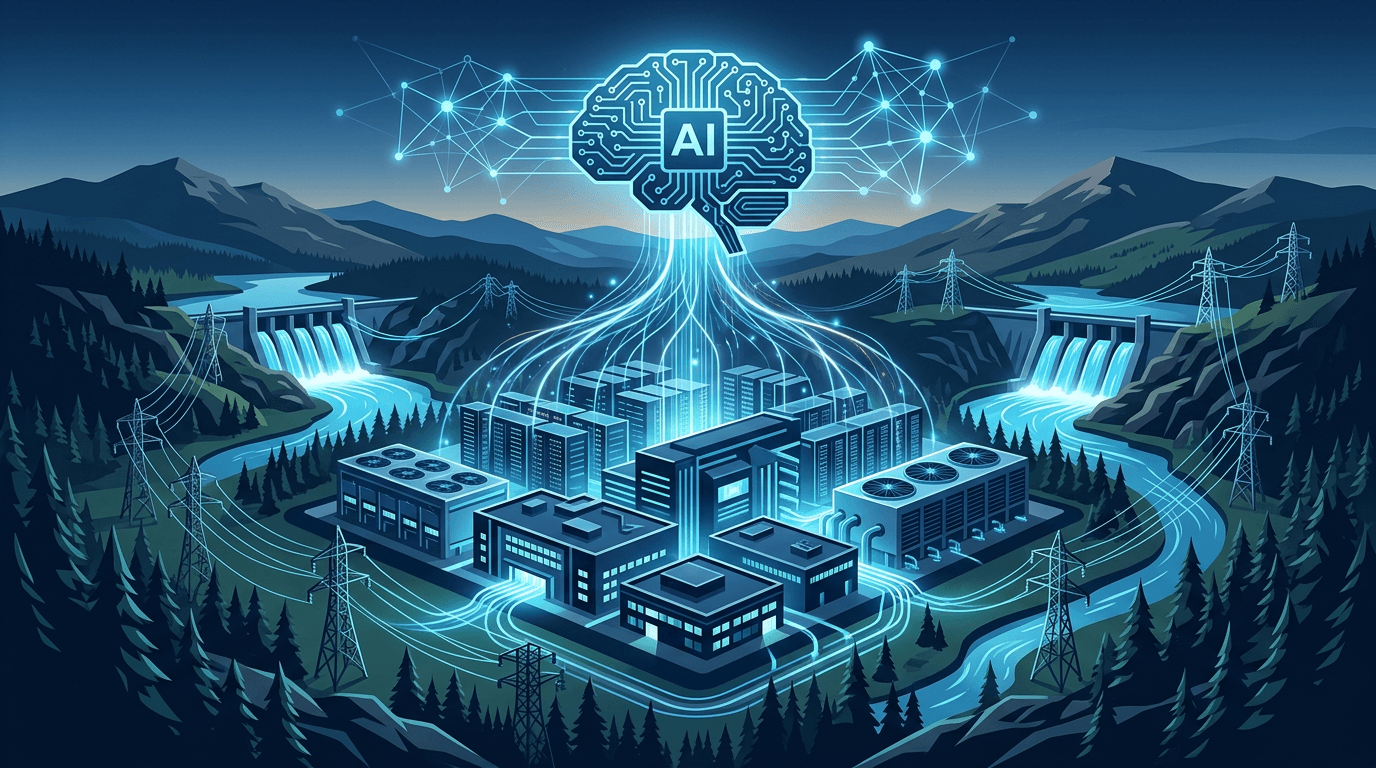
Something big is happening beneath the surface of New Hampshire's tech scene, and it's got nothing to do with software startups or hackathons. It's about power. Literal, electrical power. And a lot of it.
The AI boom isn't just a story about clever algorithms and chatbots—it's a story about infrastructure. Training a single large language model can consume as much electricity as hundreds of homes use in a year. And inference, the part where the model actually answers your questions, happens billions of times a day across millions of users. All of that compute has to live somewhere physical. It needs land, cooling systems, fiber connections, and massive amounts of reliable electricity. That's where states like New Hampshire start entering the conversation in ways they probably didn't expect.
Why Data Centers Are Suddenly Everywhere
The numbers are genuinely staggering. Goldman Sachs estimated that data center power demand could grow 160% by 2030, driven almost entirely by AI workloads. Companies like Microsoft, Google, Amazon, and a growing wave of AI-native startups are scrambling to build or lease capacity as fast as they possibly can. Northern Virginia—long the undisputed king of data center real estate—is running out of available power capacity. Utilities there literally can't connect new facilities fast enough.
So developers are looking north and east. States with cooler climates (free natural cooling = lower operating costs), available land, and access to the grid are suddenly on the radar. New Hampshire checks some of those boxes. It's got cold winters, relatively low population density in the right areas, proximity to Boston's tech ecosystem, and existing fiber infrastructure from decades of telecom investment.
We've already seen some early signals. There have been proposals and quiet conversations about large-scale data center development in the Lakes Region and parts of the North Country. Nothing massive has broken ground yet, but the interest is real.
The Grid Problem Nobody Wants to Talk About
Here's where things get complicated—and honestly, a little uncomfortable. New Hampshire's electrical grid isn't exactly built for this moment. We're part of ISO New England, the regional grid operator, and our state has some of the highest electricity rates in the country. That's partly due to our heavy reliance on natural gas and the legacy costs of nuclear power (Seabrook Station is still our single largest power source).
A single hyperscale data center can draw 100 to 500 megawatts of power. For context, that's roughly equivalent to powering 75,000 to 375,000 average American homes. Plugging that kind of load into a regional grid that's already stressed during peak demand periods is not a trivial ask. Grid operators would need years of planning, new transmission infrastructure, and serious coordination with utilities like Eversource and Liberty to make it work reliably.

There's also the renewable energy angle. A lot of these tech companies have aggressive sustainability commitments—net zero by 2030, 100% renewable matching, etc. New Hampshire's renewable portfolio is growing but it's not where it needs to be to attract companies that care about their carbon footprint. We've had contentious debates about wind projects in the White Mountains and solar permitting is still messier than it should be. That's a real competitive disadvantage.
What's Actually at Stake for NH Communities
The economic argument for data centers sounds great on paper. Tax revenue, construction jobs, high-paying operations roles. And those benefits are real—they're not fictional. But the community tradeoffs deserve honest scrutiny too.
Data centers are notoriously capital-intensive but not labor-intensive. A 200-megawatt facility might employ 50 to 100 full-time workers once it's operational. So the tax base argument is stronger than the jobs argument, and even that depends heavily on how municipalities negotiate their property tax agreements. Some states have given away massive tax breaks to lure data centers and ended up with less than they bargained for.
There's also the water question. Many data centers use evaporative cooling, which consumes enormous amounts of water. In a state where water rights and watershed protection are taken seriously—especially around our lakes—that's a legitimate concern that local planning boards will have to grapple with.
And then there's just the character-of-place stuff that's hard to quantify. Parts of New Hampshire are genuinely beautiful and rural, and residents moved there because they're genuinely beautiful and rural. A massive industrial facility, even a quiet one, changes the feel of a place.
What the AI Community Should Be Thinking About
For those of us who are excited about AI—and most of us in this community are—it's worth sitting with the complexity here rather than just cheerleading for development. The infrastructure that makes AI possible has real-world footprints. Every API call, every image generated, every document summarized runs on physical hardware that consumes energy and water and space.
That doesn't mean we should be anti-data center. It means we should be thoughtful advocates. We can push for:
- Stronger renewable energy commitments tied to any new large-scale development
- Transparent community benefit agreements that actually deliver for local towns, not just developers
- Smart grid investments that modernize NH's infrastructure rather than just adding load to an aging system
- Honest conversations at the state legislature about what kind of AI economy we actually want to build here
New Hampshire has a real opportunity here. We could become a model for responsible AI infrastructure development—the kind of place that attracts serious investment while protecting what makes the state worth living in. That's not naive idealism. Other states are starting to figure this out, and whoever gets the policy framework right early will have a real advantage.
The Conversation Is Just Starting
This is genuinely early days. The data center boom is real, the interest in New Hampshire is real, but nothing is locked in yet. That's actually the best time to have these conversations—before the permits are filed and the construction crews show up.
If you're curious about this topic, we'd love to make it part of a future NH AI Meetup discussion. The intersection of AI infrastructure, energy policy, and local community impact is exactly the kind of thing our community should be wrestling with. It's not just a tech story. It's a New Hampshire story.