
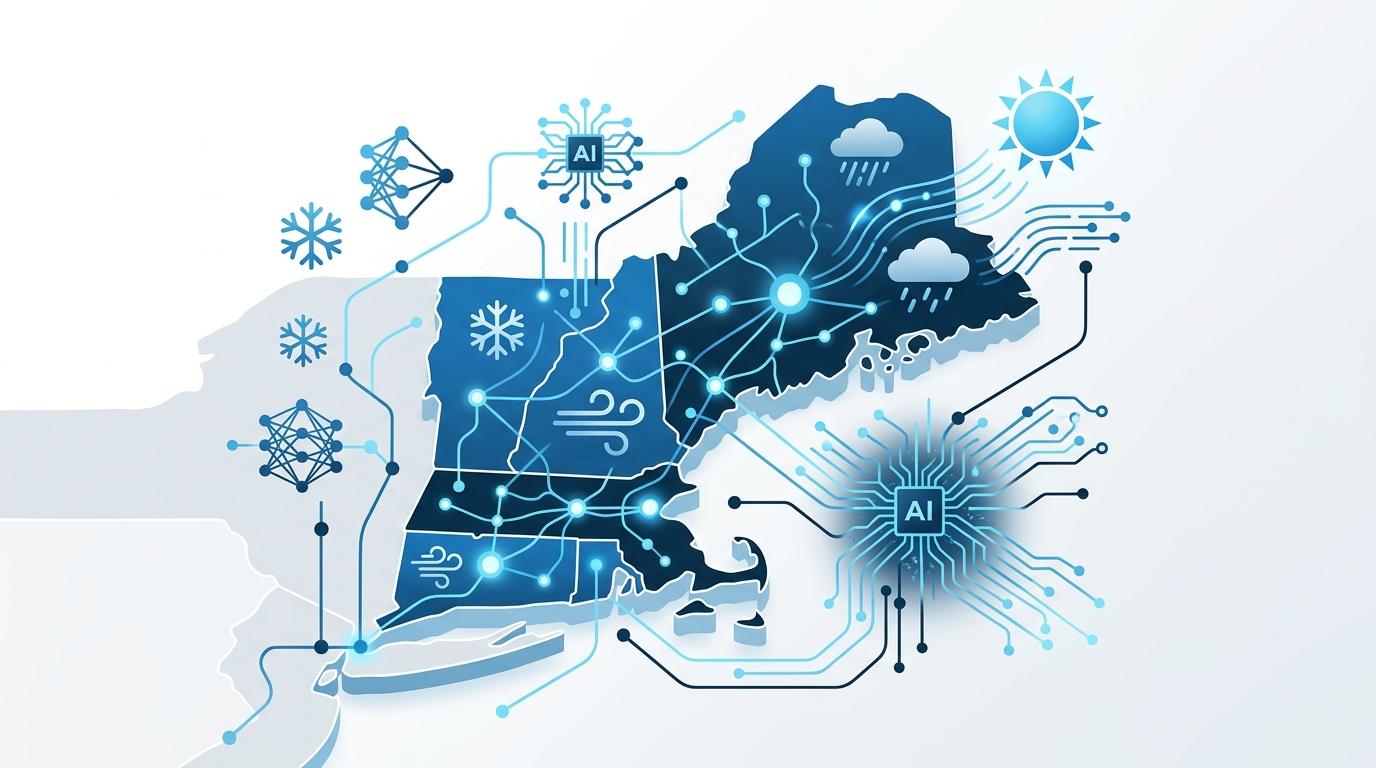
If you've lived in New Hampshire for more than one winter, you already know the drill. The forecast says two inches of snow. You wake up to fourteen. Your neighbor's weather app said sunny skies. Yours said a winter storm watch. And somehow, both were technically right at some point during the day.
New England weather is a beast. It sits at the intersection of the Gulf Stream, cold Arctic air masses, and the Atlantic Ocean, making it one of the most meteorologically complex regions in the country. Traditional forecasting models have always struggled here—and honestly, they still do. But AI is starting to change that conversation in some genuinely interesting ways.
What's Actually Happening Under the Hood
Modern weather prediction has relied on Numerical Weather Prediction (NWP) models for decades. These are physics-based simulations—things like the GFS (Global Forecast System) and the European Centre's ECMWF model—that solve massive equations describing atmospheric dynamics. They're impressive, but they're computationally expensive and they still miss hyperlocal events, which is exactly the kind of stuff that wrecks a New Hampshire commute.
What AI brings to the table is pattern recognition at a scale humans can't match. Machine learning models, particularly deep learning architectures, can ingest decades of historical weather data alongside real-time sensor feeds, satellite imagery, and radar data, then find correlations that traditional physics models either miss or take too long to compute.
Google's DeepMind released a model called GraphCast in late 2023 that made some serious waves in the meteorology community. It predicted 10-day global weather forecasts faster and, in many cases, more accurately than the ECMWF—which has long been considered the gold standard. The model uses a graph neural network trained on 40 years of ERA5 reanalysis data. That's a big deal.
NVIDIA's FourCastNet and Huawei's Pangu-Weather are doing similar things. These aren't gimmicks. They're being evaluated by actual meteorological agencies.

Why New England Is a Particularly Hard Problem
Here's the thing though—global accuracy doesn't automatically translate to local accuracy. New England has microclimates stacked on top of microclimates. The White Mountains create orographic lift that can dump three feet of snow on Franconia Notch while Concord gets a dusting. Coastal storms behave differently depending on sea surface temperatures that shift week to week. A nor'easter tracking ten miles offshore versus ten miles inland is the difference between a nuisance and a catastrophe.
This is where regional and hyperlocal AI models become really interesting. Researchers at places like MIT and NOAA have been experimenting with downscaling techniques—essentially using AI to take a coarse global forecast and sharpen it to a much finer resolution for specific regions. Think of it like upscaling a blurry photo, but for weather data.
There are also community-driven approaches gaining traction. Networks of personal weather stations (like those feeding Weather Underground or the CoCoRaHS network, which has strong participation right here in New Hampshire) are generating dense local data that AI models can learn from. The more data points you have across a small geographic area, the better a model can understand those weird local effects.
Practical Tools You Can Actually Use Right Now
Okay so this is the part that matters for most of us who aren't atmospheric scientists. What can you actually do with AI-powered weather tools today?
Tomorrow.io (formerly ClimaCell) uses a mix of traditional NWP data and proprietary sensor networks—including signals from cell towers and connected vehicles—to generate hyperlocal forecasts. Their API is used by some pretty serious enterprise clients but their consumer app is solid for personal use. Worth trying if you're tired of being caught off guard.
The Weather Company's (IBM) AI platform has been integrating machine learning into its forecasting pipeline for years. Their GRAF (Global High-Resolution Atmospheric Forecasting) model runs at roughly 3km resolution globally, which is genuinely impressive compared to older models running at 13-25km.
For the more technically inclined in our community, Open-Meteo is a free, open-source weather API that gives you access to multiple forecast models—including some of the newer ML-based ones—and lets you compare them side by side. It's a great sandbox for experimenting with forecast data.
And honestly? Building a simple ML model to predict local conditions using your own weather station data is a fantastic weekend project. A basic LSTM or even a gradient boosting model trained on a few years of hourly data from a personal station can give you surprisingly useful predictions for your specific backyard.
Emergency Preparedness Gets Smarter Too
Prediction is only half the story. AI is also being used to improve how communities respond to weather events. NH's own emergency management infrastructure has been gradually incorporating predictive analytics to pre-position resources before major storms hit—figuring out where power outages are most likely based on tree canopy data, historical outage records, and storm track predictions.
Utilities like Eversource use machine learning models to predict grid stress and prioritize restoration crews. It's not perfect—anyone who lost power for five days after the December 2023 ice storm can attest to that—but the models are getting better and the alternative (no prediction, purely reactive response) is clearly worse.
Flood prediction is another area seeing real AI investment. NOAA's National Water Model now incorporates ML components to improve streamflow forecasting across New England's river systems, which matters enormously for communities along the Merrimack, Saco, and Connecticut rivers.
The Honest Limitations
We'd be doing you a disservice if we didn't acknowledge the gaps. AI weather models are still trained on historical data, which means they can struggle with truly novel atmospheric configurations—and climate change is making those more common. A model trained on 40 years of pre-climate-change weather patterns may systematically underestimate extreme events going forward.
There's also a data equity problem. Dense sensor networks and high-quality historical data tend to exist in populated, wealthy areas. Rural parts of northern New Hampshire are data-sparse, which means hyperlocal AI predictions there are less reliable.
And interpretability remains a challenge. When a deep learning model says there's a 73% chance of a significant ice event in three days, it's hard to know why it thinks that, which makes it difficult for forecasters to sanity-check the output.
Where This Is All Heading
The trajectory is pretty clear—AI isn't replacing meteorologists, it's giving them better tools. The best forecasting systems of the next decade will probably be hybrid: physics-based models providing structural constraints, ML models filling in the gaps and catching patterns, and human experts providing contextual judgment.
For those of us living in New Hampshire, that means better storm warnings, smarter emergency response, and maybe—just maybe—fewer mornings where we're completely blindsided by a foot of snow the forecast didn't mention. That alone seems worth paying attention to.