
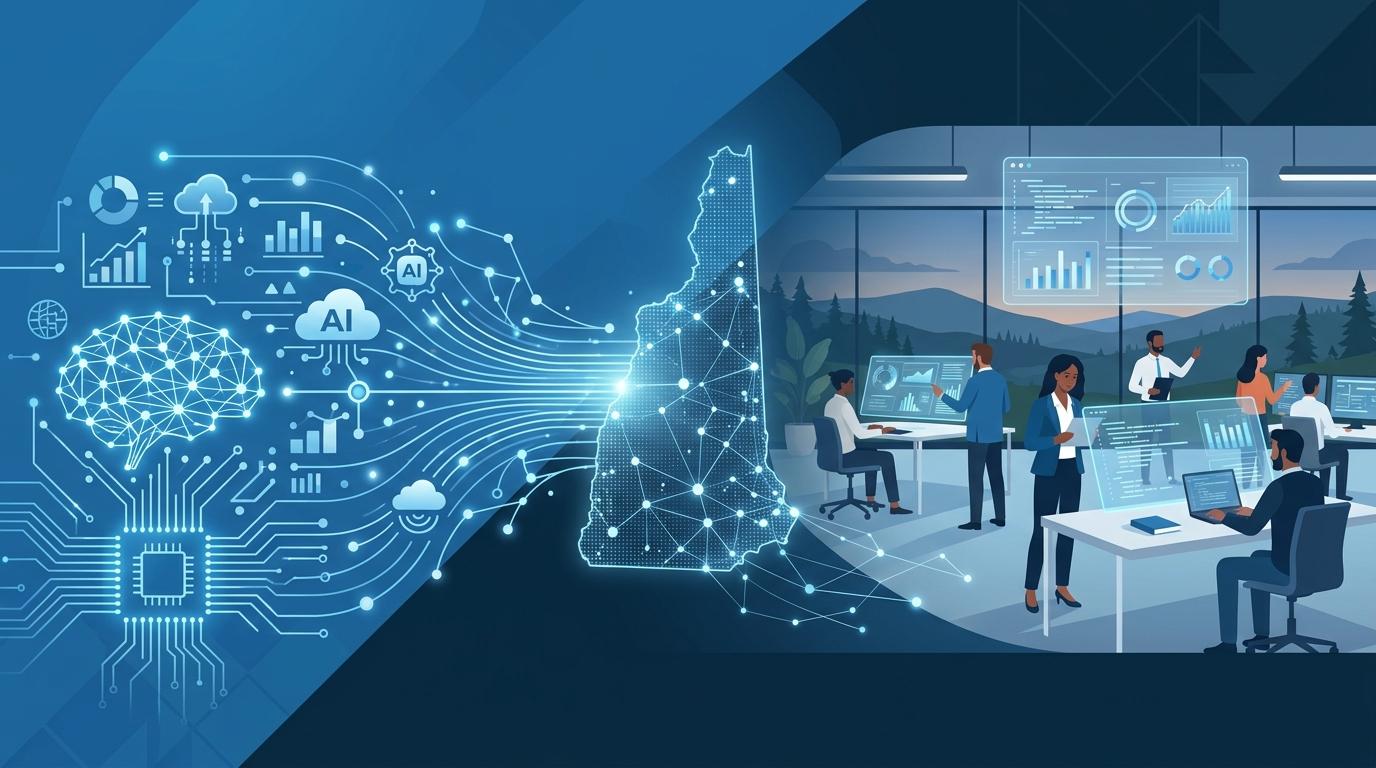
If you've been paying attention to job postings in New Hampshire's tech scene lately, something has shifted pretty noticeably. The laundry list of required skills looks different than it did even two years ago. Employers aren't just asking for Python or SQL anymore — they want people who understand how AI fits into real workflows, who can work alongside these tools rather than just knowing they exist.
We talked to a few folks in the local community about what they're seeing, and the picture that emerges is both exciting and a little overwhelming, depending on where you're standing.
What Employers Are Actually Asking For
Let's be honest about something first: a lot of job descriptions right now are kind of a mess. Companies are slapping "AI experience required" onto postings without really knowing what that means. But if you dig past the buzzwords, some real patterns show up.
Prompt engineering and LLM integration — This one surprised a lot of people, including us. The ability to work with large language models, whether that's GPT-4, Claude, or open-source alternatives like Llama, has become genuinely valuable. Not just knowing they exist, but understanding how to structure inputs, manage context windows, handle hallucinations, and integrate these models into existing applications via API. NH companies building SaaS products are hungry for this.
ML Ops and deployment — Building a model is one thing. Getting it into production, monitoring it, keeping it from degrading over time — that's where a lot of teams are struggling. Tools like MLflow, Weights & Biases, and even basic containerization with Docker are showing up constantly in local postings.
Data literacy at every level — This isn't new, but the bar has risen. Business analysts and product managers are now expected to understand model outputs, interpret confidence scores, and push back intelligently when something looks off. Pure technical folks aren't the only ones who need this anymore.
Python, still and always — Yeah, Python isn't going anywhere. If anything it's more essential than ever. The ecosystem around it — Pandas, NumPy, Hugging Face's Transformers library, LangChain — that's where a lot of the interesting work is happening.
The NH-Specific Angle
New Hampshire has a tech workforce that's somewhat unique. We've got a mix of Boston spillover — people who moved north for lower costs of living but kept their jobs or found remote work — alongside homegrown companies in Manchester, Nashua, Portsmouth, and the seacoast area. Defense contractors, healthcare tech, financial services, and a growing startup scene.
Defense and aerospace companies around the state are particularly interesting right now. They're navigating AI adoption carefully — there are compliance and security requirements that make them slower to move, but they're moving. Skills around responsible AI, explainability, and working within regulated environments are genuinely in demand there.
Healthcare tech is another big one. Companies working on clinical decision support, medical imaging, or patient data tools need people who understand HIPAA constraints alongside the technical AI stack. That intersection of domain knowledge plus AI skills? Rare and well-compensated.
Skills That Are Fading (Or At Least Commoditizing)
Here's the uncomfortable part. Some skills that felt safe a few years ago are getting squeezed.
Basic web scraping, simple ETL pipelines, entry-level data analysis — a lot of this is getting automated or at least dramatically accelerated by AI tools. That doesn't mean these skills are worthless, but they're not differentiators anymore. If your entire value proposition is "I can write a Python script to pull data from an API," that's a tough place to be.
Same goes for certain kinds of routine coding tasks. Junior developers who lean on AI assistants like GitHub Copilot are more productive, which is great — but it also means teams are hiring fewer of them. The ones who get hired need to demonstrate judgment, not just syntax knowledge.

So What Should You Actually Learn?
Okay, practical stuff. If you're trying to figure out where to spend your time, here's our honest take.
Start with the fundamentals of how these models work. You don't need a PhD. But understanding attention mechanisms, tokenization, fine-tuning versus prompting, and why models behave the way they do — that context makes everything else click. Fast.ai's courses are still great. Andrej Karpathy's YouTube content is exceptional if you want to go deeper.
Get hands-on with the APIs. OpenAI, Anthropic, Google — they all have free tiers. Build something small. A RAG (retrieval-augmented generation) pipeline, a simple chatbot, a document summarizer. The process of actually building teaches you things that no tutorial covers.
Learn about evaluation. This is weirdly underrated. How do you know if your AI system is actually working? Evals, benchmarks, human feedback loops — this is where a lot of teams are fumbling, and people who can do it well are valuable.
Don't ignore the soft skills side. Communicating AI limitations to non-technical stakeholders, managing expectations, explaining why a model got something wrong — these matter enormously. Technical chops without this are only half the package.
The Honest Bottom Line
The NH tech job market is in a genuinely interesting moment. There's real demand, real opportunity, and also real uncertainty. Companies are figuring this out as they go, which means the people who stay curious, keep building things, and show up to communities like this one — they're going to have an edge.
It's not about mastering every tool. It's about staying engaged, being willing to learn in public, and connecting with others who are navigating the same terrain. That's kind of the whole point of what we're building here at NH AI Meetup.
If you're actively job hunting or just trying to future-proof your skills, come to our next meetup and let's talk through it. Seriously. The conversations in the parking lot after these events are sometimes more valuable than anything on the agenda.