
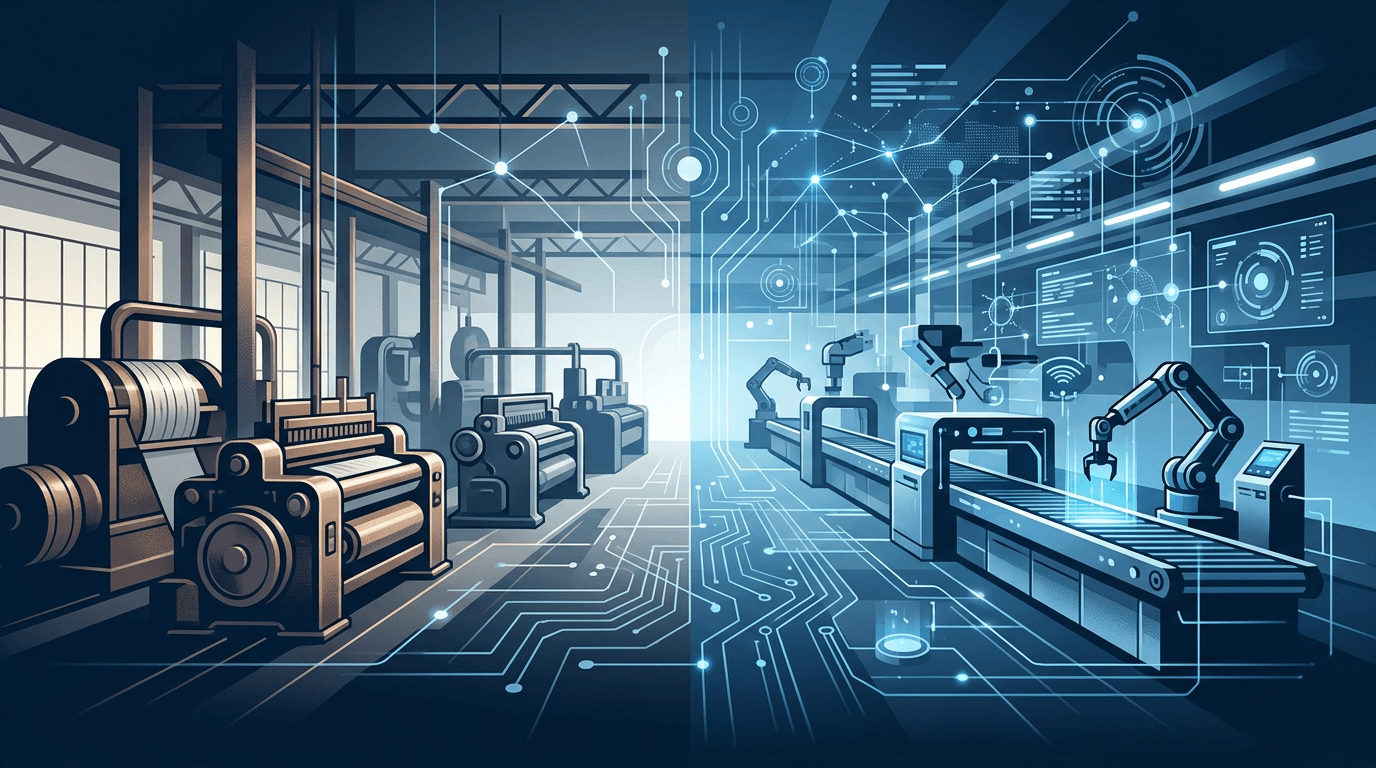
New Hampshire has been making things for a long time. From the textile mills of Manchester to the precision machining shops scattered across the Merrimack Valley, manufacturing is genuinely part of this state's identity. And right now, something interesting is happening on those shop floors — AI is showing up, not in some flashy sci-fi way, but in practical, sometimes messy, real-world ways that are worth paying attention to.
The Starting Point: Legacy Equipment Everywhere
Here's the honest reality most people outside manufacturing don't fully appreciate — a huge chunk of New Hampshire's manufacturing base is running on equipment that's 20, 30, sometimes 40 years old. CNC machines from the 90s, PLCs that haven't been updated since the Bush administration, quality inspection processes that still rely on a skilled technician's eyes and hands. This isn't negligence. It's economics. A machine that still cuts accurate parts doesn't need to be replaced just because it's old.
So when people talk about "smart factories," there's often this assumption that you rip everything out and start fresh. That's not how it works here. The more realistic path — and frankly the smarter one — is retrofitting and layering AI capabilities on top of existing infrastructure.
Companies like Formlabs (with manufacturing operations in the region) and smaller precision shops throughout Nashua and Concord are doing exactly this. They're attaching sensors to legacy equipment, feeding that data into cloud platforms, and using machine learning models to start predicting failures before they happen. Predictive maintenance alone can reduce unplanned downtime by 30-50% in some applications. For a small shop running three shifts, that's not a minor improvement — that's the difference between a profitable quarter and a rough one.
What AI Actually Looks Like on the Shop Floor
Let's get specific, because "AI in manufacturing" can mean a hundred different things.
Computer vision for quality control is probably the most visible application right now. Instead of a human inspector checking every tenth part under a light, a camera system running a trained neural network checks every single part in real time. These systems are genuinely impressive — they catch surface defects, dimensional inconsistencies, and assembly errors that human inspectors sometimes miss, especially late in a shift when fatigue sets in. The training data is the tricky part. You need thousands of labeled images of good parts and defective parts, which means the first few months of deployment are often spent building that dataset.
Process optimization is another big one. Machine learning models analyzing temperature, pressure, feed rates, and dozens of other variables can identify the optimal parameters for a given run — and then automatically adjust in real time. For injection molding shops or metal fabricators dealing with material variability, this kind of closed-loop optimization can meaningfully improve yield rates.
And then there's supply chain and demand forecasting, which honestly doesn't get enough attention. NH manufacturers supplying aerospace, defense, and medical device companies are dealing with increasingly complex supply chains. AI-driven forecasting tools are helping procurement teams anticipate shortages and adjust orders before the problem becomes a crisis. After the supply chain chaos of 2020-2022, there's a lot of appetite for anything that provides earlier warning signals.

The Workforce Question (It's Complicated)
Okay, we can't talk about AI in manufacturing without addressing the elephant in the room. Will this eliminate jobs?
Honest answer: some jobs, yes. Repetitive inspection tasks, certain data entry roles, some scheduling functions — these are getting automated. That's real and it's not nothing.
But the picture is more nuanced than the scary headlines suggest. New Hampshire is already dealing with a manufacturing workforce shortage. The state has more open manufacturing jobs than workers to fill them. In that context, AI tools that help a smaller team do more work aren't eliminating jobs so much as helping companies survive despite not being able to hire enough people.
What's also true is that AI is creating demand for new skills. Someone has to train the computer vision models. Someone has to interpret the anomaly detection alerts and decide whether to stop the line. Someone has to maintain the sensor networks feeding all this data. These roles didn't exist five years ago. They're not the same as the traditional machinist roles, which creates real transition challenges — but they're also not disappearing.
Community College System of New Hampshire deserves a shoutout here. Their advanced manufacturing programs are starting to weave in data literacy and automation fundamentals. It's not moving as fast as industry needs it to, but the direction is right.
The Real Barriers to Adoption
Talking to manufacturers across the state, a few consistent themes come up when you ask why they haven't moved faster on AI adoption.
First, cost and ROI uncertainty. A small precision shop with 45 employees doesn't have a data science team. Buying and deploying an AI-powered quality inspection system might cost $150,000 or more when you factor in integration and training. Justifying that to ownership requires a pretty clear business case, and the vendors don't always make that easy.
Second, data readiness. AI runs on data, and a lot of manufacturers are sitting on data that's fragmented, inconsistently formatted, or just not being captured at all. Before you can build a predictive maintenance model, you need years of clean sensor data. Getting there takes time and investment that precedes any visible AI benefit.
Third, and maybe most underrated — trust. Experienced machinists and plant managers have decades of intuition about how their processes work. Asking them to trust an algorithm that flags a machine for maintenance when it's running fine to their ears... that's a cultural shift, not just a technical one. The best implementations we've seen involve operators in the loop, treating AI outputs as recommendations rather than commands.
Where This Is All Heading
The trajectory feels pretty clear. The cost of sensors keeps dropping. Cloud computing gets cheaper every year. Pre-trained models for industrial applications are getting better and more accessible — you don't need to build everything from scratch anymore. Platforms like AWS Industrial AI, Siemens MindSphere, and a handful of smaller players are making it easier for mid-size manufacturers to get started without a massive upfront investment.
New Hampshire has a real opportunity here. The manufacturing base is diverse, the workforce is skilled, and there's a genuine entrepreneurial culture in this state. We're not going to out-compete China on volume or low-cost labor — we never were. But competing on precision, quality, and smart processes? That's a game NH manufacturers can win.
The transition won't be smooth or fast, and anyone telling you otherwise is selling something. But the shops that start building their data infrastructure now, that start experimenting with one or two focused AI applications, that invest in upskilling their people — they're going to be in a very different position five years from now than the ones waiting for the technology to fully mature before they act.
If you're working in manufacturing here in NH, or advising companies that are, we'd genuinely love to hear what you're seeing on the ground. This is exactly the kind of conversation the NH AI Meetup community was built for.